
Gilpin County Court Records After Arrest
Gilpin criminal cases are handled in the 1st Judicial District through Gilpin Combined Court at the Justice Center. A person may be booked into the Gilpin County Detention Facility, but that booking event is not the full court record. Law enforcement may list arrest or booking allegations first. The Colorado First Judicial District Attorney's Office then reviews the referral and decides what charges to file, if any, based on evidence and the reasonable likelihood of conviction.
That distinction is important for anyone comparing jail custody with court records after a jail arrest. The jail inmate records route is best for current custody, bond release status, and booking-related records. The court route is best for filed charges, case number, hearing dates, disposition, sentence order, protection order, and register of action. Booking photos are a separate records issue handled on the Gilpin County jail mugshots page.
Find Gilpin Court Records After Arrest
Start with the Colorado Judicial docket search when the goal is a hearing or case-status check. The docket is free and can show date, time, duration, party name, case number, hearing type, location, appearance type, and courtroom. It is not a full document portal. For documents, use the Colorado Judicial record/document request form or contact the Gilpin Combined Court clerk.
- Search by Gilpin County, Gilpin Combined Court, date range, party name, case number, case class, or attorney field.
- Read the hearing type and appearance type to separate arraignment, advisement, bond, status conference, and trial settings.
- Use the case number from the docket when requesting a complaint, information, ticket, disposition, sentence order, protection order, or register of action.
- Call the court clerk if the case is suppressed, sealed, juvenile, confidential, or missing from the public docket.
The manifest includes a screenshot of the Colorado docket search, which is the public calendar and hearing search route for Gilpin court records after arrest.
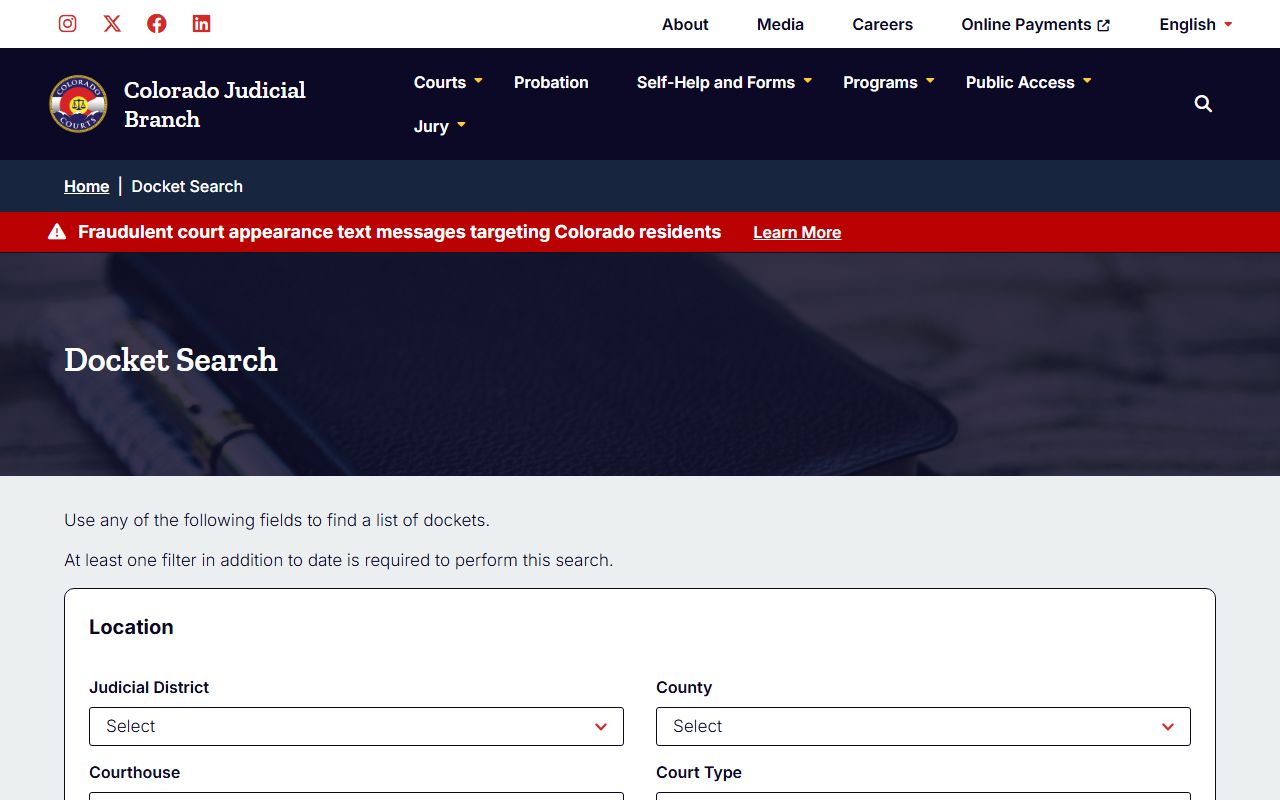
Use the docket for hearing and case-status clues, then request documents separately when a copy of the filed record is needed.
Gilpin Court Docket Fields
The docket search has more fields than most jail roster searches. A date range is part of the search, and at least one non-date filter is required. Criminal readers usually encounter case classes such as CR, M, T, and JD, but the form includes broader civil and probate choices as well.
| Field Label | Type | Required | Notes |
|---|---|---|---|
| Judicial District | Dropdown | Optional | Gilpin County is in the 1st Judicial District. |
| County | Dropdown | Optional | Select Gilpin County for local court dates. |
| Courthouse | Dropdown | Optional | Select Gilpin Combined Court. |
| Date Range | Dropdown | Date component required | Includes 6 months, 3 months, 1 month, 1 week, today, or specific date. |
| Case Class | Dropdown | Optional | Criminal users often see CR, M, T, and JD. |
| First / Last Name | Text | Optional | Party individual search fields. |
Charges Filed After Gilpin Arrest
After a jail arrest, the court record begins to take shape through a charging document. Colorado Judicial's record request form lists criminal document choices such as Complaint/Information, Disposition/Sentence Order, Protection Order, Ticket, and Register of Action. In Gilpin County, the DA's role matters because the prosecutor can file charges that differ from the arresting agency's booking allegation. A booking charge can be amended, reduced, dropped, or replaced as the case is reviewed.
| Document | Who Uses It | What It Does |
|---|---|---|
| Complaint | Prosecutor or law enforcement process | States allegations that start or support the criminal case. |
| Information | Prosecutor | Lists formal charges filed by the DA in many criminal cases. |
| Indictment | Grand jury | Charges returned through a grand jury process in eligible cases. |
| Register of Action | Court clerk record | Summarizes case activity, charges, sentences, and minute orders. |
Gilpin Charge Status Terms
Charge status is a court-record question, not just a jail-record question. An arrest shows that law enforcement brought someone into custody. A pending charge shows an accusation in the court case. A conviction requires a plea, verdict, or other final court outcome. Public readers should avoid treating every arrest or filed charge as proof that the person committed the offense.
| Status | What It Means |
|---|---|
| Pending | The charge is active and has not reached final disposition. |
| Amended | The prosecutor or court record changed the charge from an earlier form. |
| Reduced | The charge level or offense was lowered as the case moved forward. |
| Dismissed | The court record no longer proceeds on that charge. |
| Disposition | The final outcome or current resolved status of the charge or case. |
Bond After Gilpin Jail Arrest
Bond records sit between jail custody and court authority. The jail can often confirm whether someone is in custody and whether release paperwork has cleared. The court controls many bond orders and case conditions. Gilpin dockets observed in the research included hearing types such as Appearance on Bond, Hearing on Advisement, Arraignment, Show Cause Hearing, Status Conference, and Jury Trial.
| Bond Type | How It Works |
|---|---|
| Cash bond | The court sets an amount that must be paid through the authorized jail or court process. |
| Surety bond | A licensed bail agent posts bond for a fee where commercial bail is allowed. |
| Personal recognizance | Release is based on a promise to appear, with conditions set by the court. |
| No-bond hold | Release is not available until further court or holding-agency action. |
| Detainer | Another agency's hold or notice may affect release even when local bond exists. |
DA Review After Gilpin Arrest
The First Judicial District Attorney explains that law enforcement investigates reported crimes and may arrest when probable cause exists, while prosecutors decide what charges to file based on evidence and likelihood of conviction. The office serves Gilpin and Jefferson counties, and the DA site names Alexis King as District Attorney. Court records, not the DA website, are the public route to confirm filed charges.
The DA's discovery page is useful for defendants and interested parties. Attorneys use statewide eDiscovery after accepted entry of appearance. Self-represented defendants must contact the Discovery Department and pick up discovery in person with government-issued ID. Interested-party criminal justice record requests are handled through the DA's records request route.
CBI Criminal History Records
The CBI Internet Criminal History Check is a statewide Colorado search, not a Gilpin jail roster and not a full court document portal. CBI says the online report viewed during research cost $6. The manual or notarized letter option was listed at $13, with up to three business days plus mailing. Required search criteria are first name, last name, and date of birth, while Social Security number is optional but recommended if known.
CBI public criminal-history checks contain fingerprint-supported Colorado arrest records only. The CBI FAQ says the public check does not include warrants, sealed records, or juvenile records. A CBI result can help with broad criminal history, but Gilpin County court records after a jail arrest still require the court docket or record request form for the filed case documents.
Charges and Convictions
Being arrested, charged, and convicted are different events. A person arrested in Gilpin County has been taken into custody based on law-enforcement action. A person charged has an accusation filed in court. A conviction requires a plea, verdict, or other judgment. Public records can contain all three kinds of information, but they do not mean the same thing.
| Charge | Conviction | |
|---|---|---|
| Stage | Accusation filed in court | Resolved outcome after plea, verdict, or judgment |
| Proof level | Less than final trial proof | Final court outcome for that offense |
| Where found | Docket, charging document, or ROA | Disposition or sentence order |
| Why it matters | Can change or be dismissed | May carry sentence and collateral consequences |
Sealed and Expunged Records
Colorado law includes record-sealing provisions in Title 24, Part 7. Sealing can limit the public response to eligible arrest or criminal records, but it does not erase all government access for every lawful purpose. The research did not identify a Gilpin-specific sealing shortcut. Juvenile, suppressed, confidential, and protected records may require photo ID or may not be publicly available through the normal public docket or document request path.
| Sealed | Expunged | |
|---|---|---|
| Public visibility | Restricted from ordinary public access | Treated more like removal from ordinary public view where law allows |
| Government access | Law enforcement or courts may retain access for lawful reasons | Access depends on the specific law and order |
| Eligibility | Based on Colorado statute, case type, disposition, and timing | More limited and often tied to special categories |
| Where to start | Colorado Judicial or legal counsel | Colorado Judicial or legal counsel |
Restricted Gilpin Court Records
Colorado Judicial says access can be restricted by statutes, court rules, Supreme Court Rules, Chief Justice Directives, local orders, and other legal authorities. Suppressed cases, juvenile or probate matters, and documents with confidential or protected information may require a U.S. government-issued photo ID or may be withheld from the public. A missing public docket result does not prove that no case exists. It may mean the search fields are wrong, the case is not filed yet, the case is restricted, or the custody question belongs with the jail rather than the court.
Important: This private resource is not a consumer reporting agency and cannot be used for FCRA-covered screening decisions.